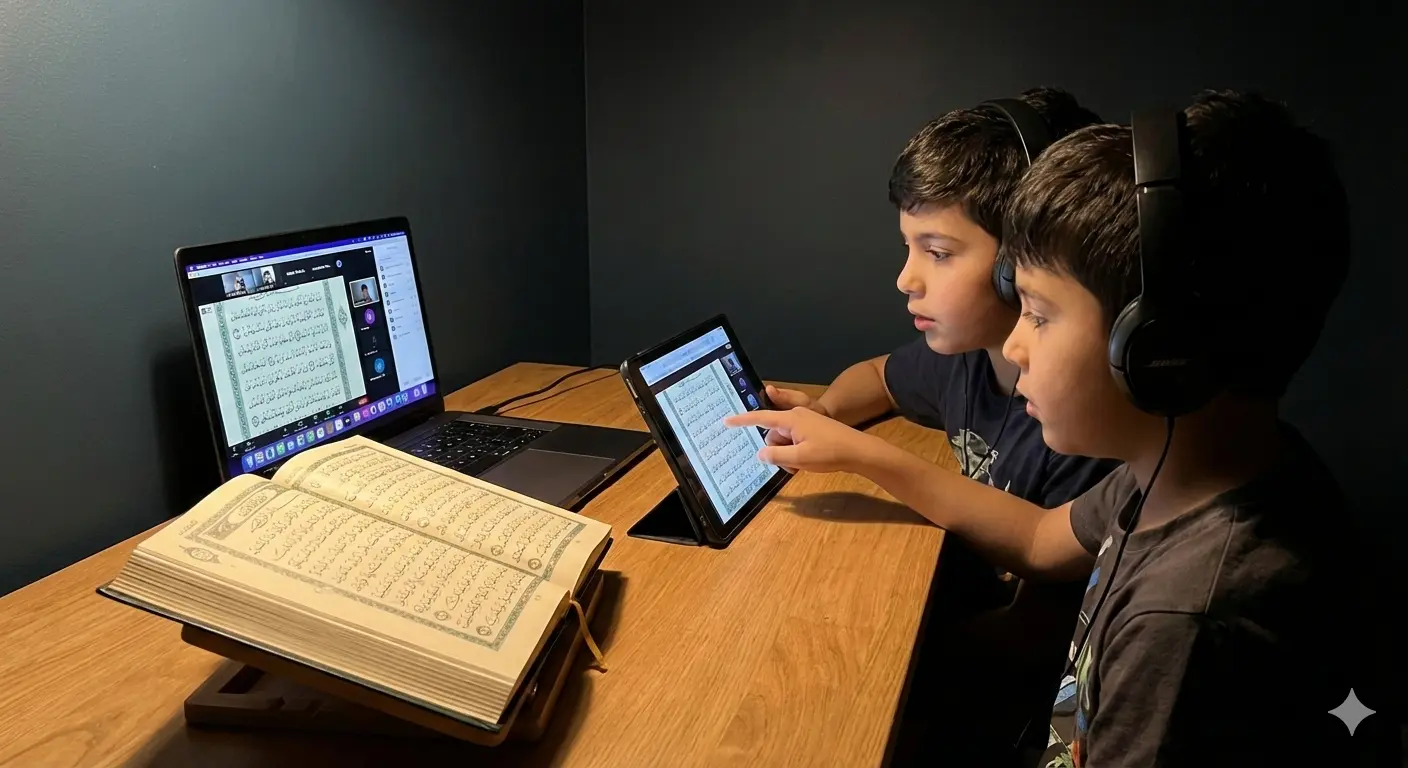
Buruj Academy’s Quranic Sciences (‘Uloom Al-Quran) Course delivers systematic training in the interpretive tools that scholars use to unlock meaning from the Quran itself. Students learn Tafsir methodologies, Asbab al-Nuzul analysis, Nasikh wa Mansukh principles, and the linguistic frameworks that reveal why certain words were chosen over others.
Buruj Academy doesn’t teach ‘Uloom Al-Quran as a history lesson. Buruj Academy’s qualified Islamic studies instructors guide students through practical application: how to recognize thematic connections across Surahs, how revelation circumstances clarify legal rulings, how variant recitations (Qira’at) affect interpretation. The course builds the analytical skills students need to study Tafsir independently and approach the Quran with scholarly awareness, not just devotional reverence.

Transform from a complete beginner to a confident Quran reader
Buruj Academy’s Quranic Sciences (‘Uloom Al-Quran) Course introduces students to the foundational disciplines that underpin Islamic scholarship: revelation history, compilation processes, variant readings, abrogation principles, and Tafsir methodologies. The curriculum moves systematically through topics like Makki vs. Madani Surahs, reasons for revelation (Asbab al-Nuzul), the seven Qira’at, Quranic rhetoric (Balagha), and how classical scholars extracted legal rulings from Quranic verses.
Students work through case studies showing how different ‘Uloom disciplines intersect—for instance, how knowing a verse’s revelation context (Sabab al-Nuzul) combined with understanding abrogation (Nasikh wa Mansukh) clarifies its legal application. Buruj Academy’s instructors don’t rush through definitions. They model the thought process: when reading Tafsir, which ‘Uloom principles is the scholar applying, and why does that matter for understanding the verse’s meaning today?
'Uloom Al-Quran curriculum introduces Quranic sciences gradually, building from basic categories to advanced interpretive tools. Each discipline is taught not in isolation but as part of the larger framework students need for informed Quran study.
Buruj Academy’s curriculum begins with how the Quran was revealed, preserved, and compiled—not as dry history but as the foundation for understanding textual reliability. Students learn the difference between revelation (Wahy) and recitation (Qira’ah), the role of the scribes (Kuttab al-Wahy), Uthman’s standardization of the Mushaf, and why manuscript variations exist without contradicting preservation.
Students learn to distinguish Makki from Madani revelations based on themes, linguistic style, and legal content. Buruj Academy’s instructors explain how recognizing these categories helps students understand the Quran’s pedagogical sequencing: Makki Surahs establish Aqeedah and Tawhid, while Madani Surahs detail Shariah and community rulings.
Many verses are misunderstood because students don’t know the circumstances that prompted their revelation. Buruj Academy’s Quranic Sciences (‘Uloom Al-Quran) Course teaches students how to identify authentic Asbab al-Nuzul narrations, assess their reliability, and use them to resolve ambiguities in Tafsir.
Abrogation is often taught poorly—either oversimplified or avoided entirely. Buruj Academy’s instructors walk students through the conditions for abrogation, the difference between abrogated rulings (Hukm) versus abrogated recitation (Tilawah), and classical scholarly debates on which verses are actually abrogated. Students leave understanding why this discipline matters for deriving legal rulings without contradicting the Quran’s eternal relevance.
Watch real testimonials from students who transformed their Quranic journey with us
Buruj Academy's Quranic Sciences ('Uloom Al-Quran) Course equips students with the interpretive frameworks scholars use to study the Quran systematically.
Buruj Academy's course builds capabilities students need for independent Quran study. Outcomes focus on practical skills: recognizing when to apply which interpretive tool, assessing Tafsir commentary critically, and approaching verses with scholarly rigor.
Most students read Tafsir passively, accepting interpretations without understanding the reasoning behind them. Buruj Academy's curriculum changes that approach. Students learn to identify when a Mufassir is applying Asbab al-Nuzul, linguistic analysis, abrogation principles, or juristic reasoning. They develop the literacy to follow complex scholarly arguments and understand why interpretations differ.
Knowing a verse's Sabab al-Nuzul isn't optional—it's often the key to correct interpretation. Buruj Academy's Quranic Sciences ('Uloom Al-Quran) Course trains students to locate these contexts, verify their authenticity, and apply them appropriately. Students practice distinguishing between specific occasions that prompted revelation and the verse's general application. This skill prevents both overgeneralization and inappropriate restriction of Quranic guidance.
Variant readings confuse many students. Buruj Academy's instructors demystify the seven Qira'at, explaining their chain of transmission (Sanad), grammatical implications, and how they expand interpretive possibilities. Students see how these variations are controlled—rooted in the Prophet's teaching, not scribal errors. This knowledge strengthens their confidence in Quranic preservation while appreciating the Quran's linguistic depth.
The Quran isn't a random collection of verses. Buruj Academy's curriculum teaches students to trace themes across Surahs, recognize structural patterns (Munasabah), and understand how the Quran's arrangement itself conveys meaning. Students practice mapping thematic connections—how Surah Al-Baqarah's legal rulings build on Surah Al-Fatiha's foundational prayer, for instance. This holistic view transforms how they engage with Quranic text.
Buruj Academy's Quranic Sciences ('Uloom Al-Quran) Course prepares students for deeper scholarship. Graduates leave equipped to study Usul al-Tafsir, explore specialized 'Uloom branches, or pursue formal Islamic studies with the prerequisite knowledge already established. The course doesn't make students scholars—it gives them the tools to learn like scholars. That's the difference between casual Quran reading and disciplined Quran study.
Learn from qualified native Arab scholars with years of teaching experience
Qur’an & Tajweed Teacher
Memorized 26 Juz’ | 400+ teaching hours | Noor Al-Bayan & Tajweed Specialist | Interactive Lessons
Qur’an Tutor | Multiple Ijazah Holder | Special Needs Specialist
4,500+ Teaching Hours | Ijazah in Hafs, Ibn ‘Amer & Abu ‘Amr | Teaching Arabs & Non-Native Speakers | 7+ Years Experience
Real transformations from students who mastered the Quran with our courses
Buruj Academy’s Quranic Sciences (‘Uloom Al-Quran) Course provides the interpretive training students need to move from passive Quran reading to active scholarly engagement.
Buruj Academy built its Quranic Sciences ('Uloom Al-Quran) Course for students who want rigorous training, not superficial overviews.
Buruj Academy's instructors hold credentials in Islamic studies from recognized institutions, with specialized training in Tafsir and 'Uloom Al-Quran. They don't simplify concepts—they scaffold them systematically so students build genuine competency.
Buruj Academy's Quranic Sciences ('Uloom Al-Quran) Course doesn't isolate disciplines. Students learn Asbab al-Nuzul while practicing its application to real verses. They study Nasikh wa Mansukh while analyzing disputed rulings. Theory and practice develop together.
Every 'Uloom discipline is taught through worked examples. Students see how scholars used these tools historically, then practice applying them to new verses. This method builds transferable analytical skills, not memorized facts.
Adults studying Quranic sciences often juggle work, family, and other responsibilities. Buruj Academy's instructors adjust lesson depth and homework expectations based on each student's capacity. Progress matters more than speed.
The Quranic sciences depend on linguistic precision. Buruj Academy connects 'Uloom study with Tajweed rules and Quranic grammar, showing how pronunciation affects meaning and how morphology reveals interpretive possibilities. These disciplines reinforce each other.
Specialized Islamic studies courses are often expensive. Buruj Academy prices its Quranic Sciences ('Uloom Al-Quran) Course to remain accessible to students committed to long-term learning, regardless of financial background.
Buruj Academy’s Quranic Sciences (‘Uloom Al-Quran) Course equips students with the scholarly tools needed for disciplined, informed Quran study.
✓ Cancel anytime · ✓ No hidden fees · ✓ 100% satisfaction guarantee
Students often ask about prerequisites, lesson structure, and how this course integrates with other Islamic studies programs.